The Philosophy of Light and the Prohibition of Gold: Why Was Lusterware Born?
- Alireza
- No Comments
Introduction In the history of art, great inventions often arise from strict limitations. One of the most fascinating examples of this paradox is the creation of Lusterware (Zarrin-fam) ceramics. Why did the potters of the Islamic Golden Age spend centuries perfecting a technique to make clay look like gold? Was it merely for aesthetic pleasure, or was there a deeper force at play?
The answer lies at the intersection of religious law, social luxury, and mystical philosophy. Lusterware is not just a beautiful type of pottery; it is a “Theological Compromise” and a masterpiece born from the prohibition of precious metals. In this article, we explore the fascinating story of how a religious ban ignited one of the greatest artistic revolutions in ceramic history.
The Dilemma: A Ban on Luxury
To understand the birth of Lusterware, we must first look at the social and religious context of the early Islamic era (specifically the Abbasid Caliphate in the 9th century).
Islamic Tradition (Hadith) strictly prohibited the use of gold and silver vessels for eating and drinking. The use of these precious metals for tableware was seen as a sign of arrogance, excess (Israf), and a distraction from spiritual modesty. It was reserved for the afterlife, not the earthly table.
However, the Caliphs, the elite, and the wealthy merchants of the time still desired luxury. They wanted the grandeur of the Byzantine and Sassanian courts. They faced a unique problem:
The Desire: To dine on plates that glittered like the sun.
The Law: The prohibition of using actual gold.
The Solution: Alchemy as an Escape Route
Necessity—or in this case, desire—became the mother of invention. The potters of Basra, and later Egypt and Iran (Kashan and Rey), began experimenting with chemistry to solve this problem.
They asked: “Can we create a vessel that looks exactly like gold but is made of humble clay?”
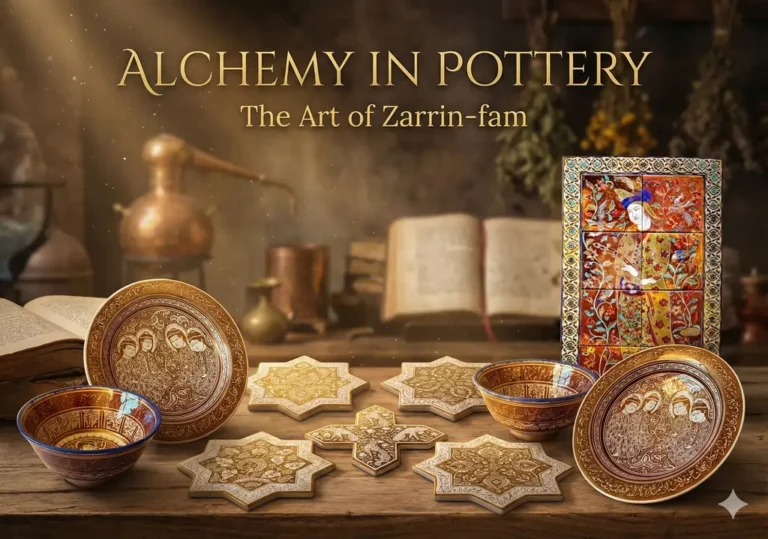
The result was Lusterware. By using copper and silver oxides in a reduction kiln (as detailed in our previous article), they created a metallic sheen that mimicked gold perfectly.
Ideally: It satisfied the religious law because, materially, it was just “mud” and “dirt.” It had no intrinsic value like gold.
Visually: It satisfied the desire for luxury because it shimmered and impressed guests just like precious metal.
This was the great deception—or rather, the great ingenuity—of Lusterware. It was “The Gold of the Pious.”
The Metaphysics of Light: Glare of the Divine
Beyond the legal loopholes, there is a deeper, more spiritual philosophy behind Lusterware, particularly in the Iranian context where Sufism (Islamic Mysticism) flourished.
In Islamic philosophy, “Light” (Nur) is a central metaphor for God. The Quranic verse ayat al-nur states: “God is the Light of the heavens and the earth.” Therefore, capturing light on a physical object became a spiritual pursuit.
1. The Dematerialization of Matter
Lusterware creates an optical illusion. When you look at a Luster tile or bowl, the solid form seems to dissolve into a flash of light. The pottery denies its own solidity. This aligned perfectly with the Sufi belief that the material world is fleeting and only the “Divine Light” is real.
2. The Mirror of the Soul
The reflective surface of Zarrin-fam required the viewer to interact with the object. As you move the vessel, the colors change from gold to brown to purple. This “movement” of light was seen as living energy, distinguishing it from the static shine of real gold.
From Basra to Kashan: The Migration of a Secret
The secret of making this “fake gold” was closely guarded. It started in Iraq (Basra) in the 9th century, moved to Egypt (Fatimid era) where it found great patronage, and finally reached its zenith in Iran (Seljuk and Ilkhanid eras).
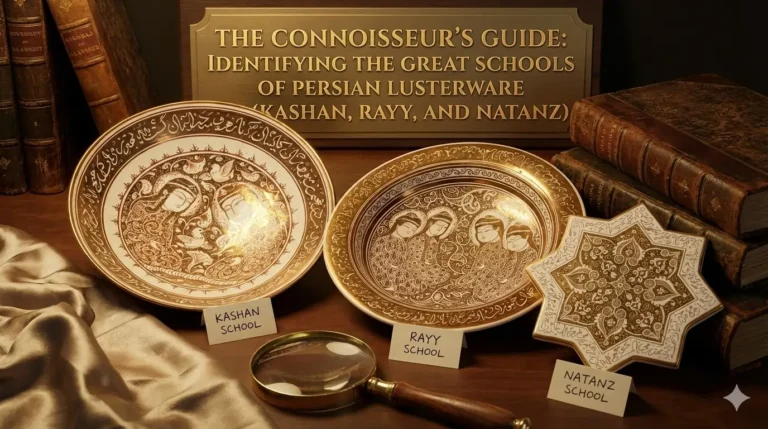
It was in the Iranian cities of Kashan, Rey, and Natanz that Lusterware evolved from simple geometric designs to complex narratives. Persian potters added poetry, figures, and stories to the golden shine. The inscriptions on these vessels often reveal their use: they were not just for eating, but for poetry recitals and gathering of the elite literati.
Lusterware in the Modern Era: A Lost Symbol?
Today, we no longer have a ban on gold vessels, and we have cheap alternatives like electroplating. However, Lusterware remains far more valuable than gold-plated items. Why?
Because Lusterware represents the triumph of human skill over material value. A gold plate is valuable simply because the metal is expensive. A Lusterware plate is valuable because a master potter risked months of work to tame fire and chemistry.
When we look at the works of masters like the Tavallian family in Natanz today, we are seeing the continuation of this ancient philosophy: turning the worthless earth into something that reflects the heavens.
Conclusion
Lusterware was born out of a prohibition, but it survived because of its beauty. It started as a way to circumvent a religious ban on gold, but it evolved into an art form that celebrated the spiritual meaning of light. It teaches us that when art faces barriers, it doesn’t stop; it transcends. The “Golden” pottery of Iran is a reminder that true value comes not from the material used, but from the spirit and skill infused into it.
Related Posts